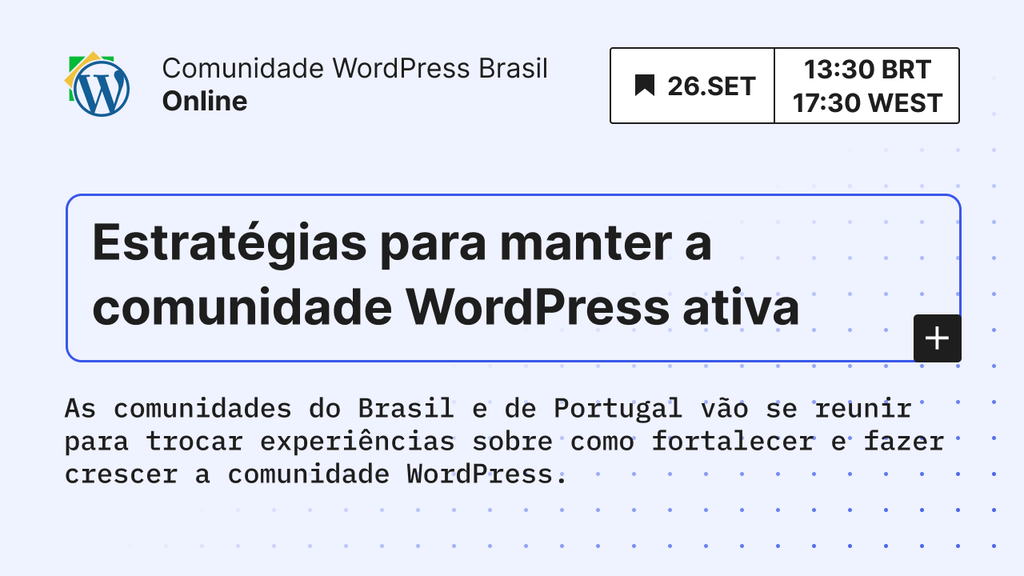
On September 26 I organized the WordPress Brasil Meetup Online #5: Strategies to keep the WordPress Community active, and I invited people who were somehow involved in organizing events in Brazil and Portugal to join. This is the second time I’ve done this. The first one was right after WordCamp Europe 2026, where at the end we talked about some ideas on how to organize events, and we realized that it would be great to hold a recurring event to explore this topic further and bring the communities from both countries closer. And this is exactly what the September event was about.
We had 14 different people on the call, across 3 countries: Brazil, Portugal and the Netherlands. It was an exciting and long discussion; the meeting lasted almost 3 hours! At the end I had a good feeling that these discussions can drive a positive impact on the community. Thanks to Amanda Cardoso, Caio Ferreira, Christian van ‘t Hof, Débora Venâncio, Fellyph Cintra, Flaubert Henriques, Gilberto Tavares, Guga Alves, José Freitas, Luís Semedo, Marco Andrei Kichalowsky, Pedro Fonseca, Rúben Martins and Thaís Lima for joining and contributing to the conversation.
Since these meetings are not recorded on purpose, to make everyone feel more comfortable, here is an organized summary of what we talked about:
Cross-country collaboration
- Idea to hold an online WordCamp for the Portuguese-speaking community, bringing together not only Brazil and Portugal, but also other Portuguese-speaking countries. The people who joined the meeting already have a lot of experience organizing events and giving presentations, so an online event like this seems very achievable. But we could start with a smaller online event before trying a WordCamp.
Planning and scheduling
- One idea is to have a fixed day each month, so it’s easier to organize and people know there will always be an event on that day.
- Try to schedule multiple months of meetups ahead, so the public (and organizers) have a clear view of when to expect the next event.
- The São Paulo community will start holding events again, and they have secured a place for the next 3 months.
- One city was able to book a space 12 months ahead, making the process of organizing events easier and more predictable.
- Importance of rotating the host city of the national WordCamp, and also the teams organizing the local meetups, so there are always different styles of events, attracting different people.
Shared resources
- Make a list of people who could speak at events (WordCamps and meetups) and share it with other organizers.
- Make a similar list for sponsors.
Meetup formats and venues
- A meetup doesn’t always need to be in a place with a screen (or projector); it can be held in different kinds of places, like a restaurant. The comeback meetup in Curitiba was at an empanada restaurant. If you start holding events regularly, this shows that there is interest in them and helps the organizers find more places.
- If you can’t find a speaker, you can always hold a roundtable discussion or try other formats like hands-on sessions, support, working on translations, …
- Make the event fun. Some examples from the Curitiba community: a cake when WordPress reached 25% of all websites, a 15-year anniversary party with a speakers’ waltz (anyone from the audience could come up to the front and give a quick presentation about something they knew), funny introduction slides, … If people see that the organizing team is having fun, these good vibes will be contagious to the attendees too.
Organizing team
- It’s important to have a “core team” that will make the event happen no matter what. This team usually has a main organizer, who keeps everyone engaged and aligned to make things happen.
- Having two people organizing an in-person event is the minimum, so while one person is solving something for the event, the other can greet the people who are arriving.
- Understand what is sustainable for the organizers and plan the event schedule around it. Since one of the secrets to a successful meetup is consistency, it is critical that it is sustainable for the people making it happen.
- There will always be someone from the audience who can’t make a specific day or location; learn to be comfortable with this, and try experimenting with different schedules and venues when possible. But in the end, if it is not sustainable for the organizers, the event will stop happening.
Attracting new audiences
- How can we attract a new audience to the events, especially young people? This is the million-dollar question the community is dealing with right now, since most of the people attending events are already long-time participants in the community (and mostly over 30).
- Promoting events as “WordPress” events can be a turn-off for many people, because some of them think of it as old and boring technology. In other words, WordPress is not sexy anymore.
- In GDG (Google Developer Groups) they have a rule that they need to talk about Google at least every 90 days (or something like this). Could we have something similar in the WordPress community, where events can also show other solutions and invite people from outside the WP community?
- One example is WordPress Day for AI Faro, where they are inviting people who don’t use WordPress.
- What other communities (like AI, builders, marketers, ecommerce, …) could we partner with to hold an event together? This could help reach a different audience.
- In GDG (Google Developer Groups) they have a rule that they need to talk about Google at least every 90 days (or something like this). Could we have something similar in the WordPress community, where events can also show other solutions and invite people from outside the WP community?
- We need to think about meetups as something that will motivate people and make them feel excited, and the most common meetup format (watching a talk and then eating something) is probably not the best way to do this. What other types of events could we hold that are different from what people expect?
- What value can WordPress bring to the new generation?
- Find ways to highlight young people during the event; this will probably attract more of them.
- What can we do to focus the themes on solving problems, instead of on the technology?
- Show different ways of solving a problem, with WordPress and with other tools too, and leave it open for each person to use what best fits their needs or preferences.
- Remember that “WordPress is technology and WordCamps/meetups are people,” and think about what we can do to make the most of the space where people meet and share experiences.
- Don’t emphasize “WordPress” (the technology) as the main topic of the presentations, and focus on the problem to be solved.
- One example was a presentation about the Abilities API that only showed what it made possible at the very end. If it had started with the practical examples, it would have been much more captivating.
Marketing
- Focus the communication (including promotional materials like flyers and banners) on the problem the event is trying to solve, not on the fact that it is a WordPress event.
- Proactively search for people who work with WordPress, or who seem to be a good fit for the event, and reach out to invite them to the events.
- This includes reaching out to people who create content about WordPress, or who talk about technology and could talk about WordPress, to help promote the events.
- Create different types of communication for people who RSVP and for people who don’t.
- Communication with the community can’t be treated as a “low-maintenance friendship,” where announcing an event a few days before is enough for people to show up and participate. It’s a high-maintenance relationship that needs constant, ongoing communication to keep people engaged and excited about what we’re doing.
- Try different communication channels to reach different audiences; we need to diversify to attract new people.
That’s it! I hope this list will inspire people to try different things to engage the WordPress community.
We will schedule the next cross-country Portuguese-speaking meeting in December, and I will share the details in WordPress Slack. See you there!

Leave a Reply